
Biscoff Ice Cream Recipe
 Add Preferred Source

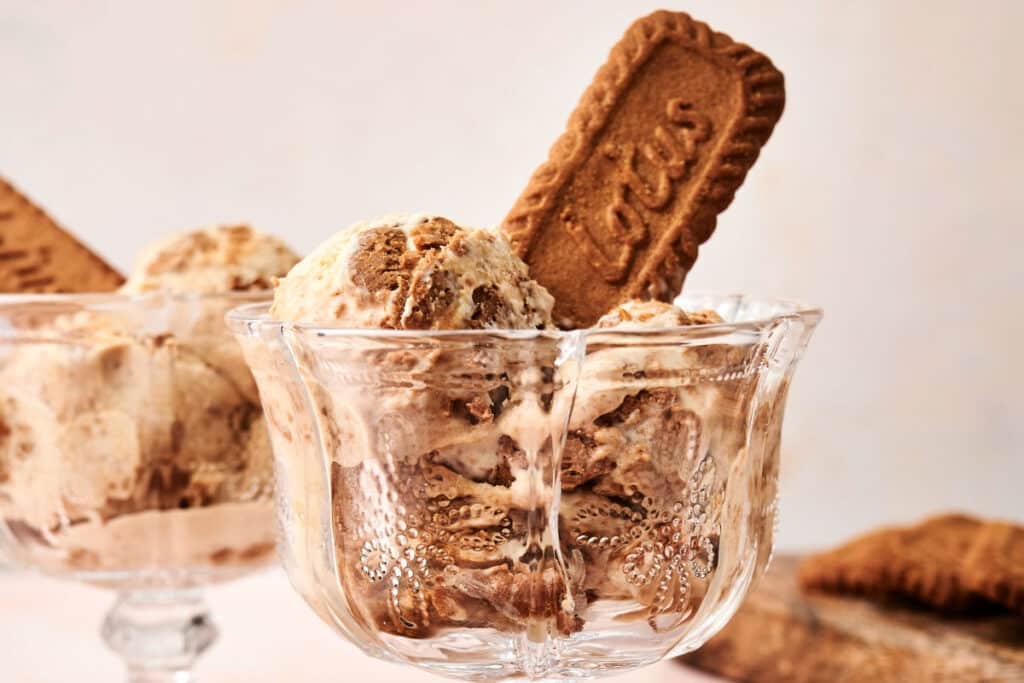
If there’s a Biscoff lover in your house, this Biscoff ice cream is the homemade answer to the tub at the store. It has a smooth cream base carrying the spiced caramel flavor of Lotus cookie butter, with crushed Biscoff cookies folded through and ribbons of extra spread swirled in at the end.
I make it in a churner rather than the no-churn way, and the reason is texture. Churning keeps the ice cream dense and scoopable instead of airy, so the Biscoff flavor stays front and center in every bite.
This post contains affiliate links. As an Amazon Affiliate, if you purchase through those links, I earn a commission. Thank you!
Why You’ll Love This Recipe
- It runs on five ingredients you can find in one trip to the grocery store, and one of them is a jar of Biscoff spread you probably already own.
- The base is eggless, so there’s no custard to cook, cool, and babysit. You whisk, churn, and freeze.
- Half the Biscoff spread goes into the base and half gets swirled in at the end, which gives you flavor all the way through plus visible ribbons on top.
- It scoops like a proper ice cream, not a soft frozen mousse, because churning builds a denser set than the whipped no-churn method.
- You can make it days ahead and keep it in the freezer, ready to scoop whenever someone wants a bowl.
Ingredients You’ll Need
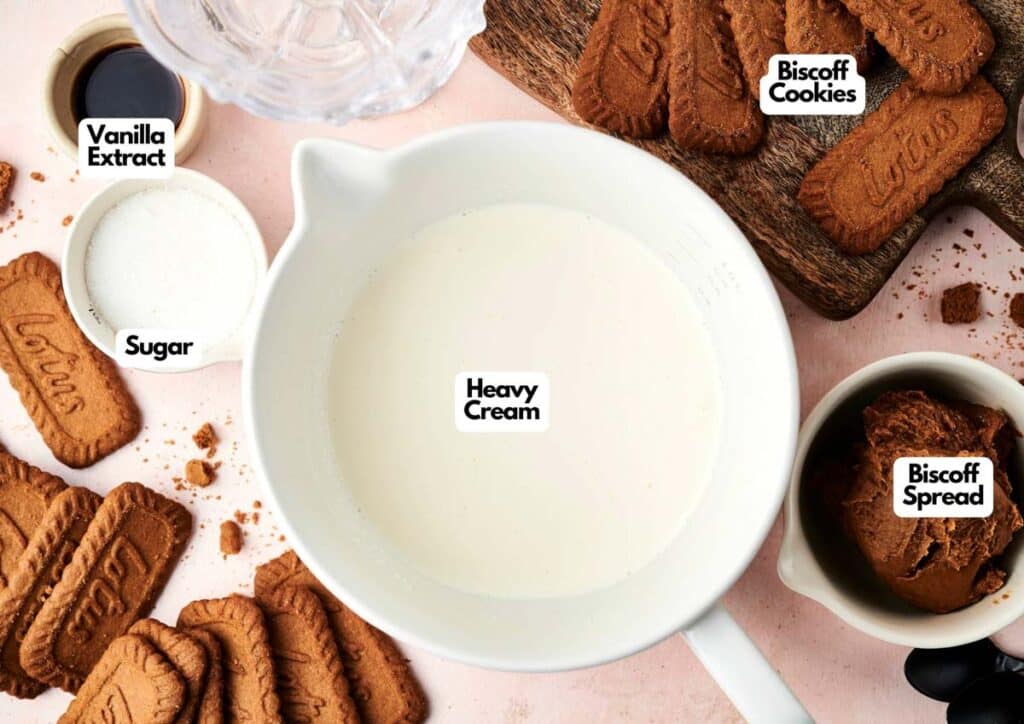
You’ll need all the ingredients shown in the photograph below.
- Heavy cream. The body of the ice cream, and it is doing the structural work here, so this is not the place to swap in half-and-half. You whisk it just enough to dissolve the sugar, not to whip it to peaks, which is a common mix-up with no-churn recipes that start the opposite way.
- Biscoff spread. Also sold as Lotus cookie butter, it’s the whole flavor. You use it in two places, half whisked into the base and half swirled in at the end, so keep that division in mind when you open the jar. If it’s stiff and won’t pour, a few seconds of warmth in the microwave loosens it.
- Biscoff cookies. They go in crumbled, for crunch and for the cookies-and-cream texture. Crush them fairly coarse. Dust-fine crumbs disappear into the base, and you lose the contrast that makes this worth making. If you want to go further with the same flavor another day, the same cookie turns up in my soft Biscoff sandwich cookies.
- Sugar. It sweetens and also keeps the set softer and more scoopable, so don’t cut it on instinct. Whisk until it fully dissolves or the finished ice cream can turn grainy.
- Vanilla extract. This rounds out the spice of the Biscoff. Pure vanilla is worth it in a base this simple, where there’s nowhere for a harsh imitation note to hide.
How to Make Biscoff Ice Cream
A complete printable recipe and the measurements in both US customary and metric are available in the recipe card below.
Whisk the base
In a large bowl, whisk the heavy cream, sugar, vanilla, and half of the Biscoff spread for about two minutes, until the sugar has fully dissolved. A few streaks of cookie butter left in the bowl are fine; they only add flavor. Keep this base cold until it goes into the machine, because a base that has warmed up on the counter is the first reason a batch never firms up properly.
Churn to soft serve
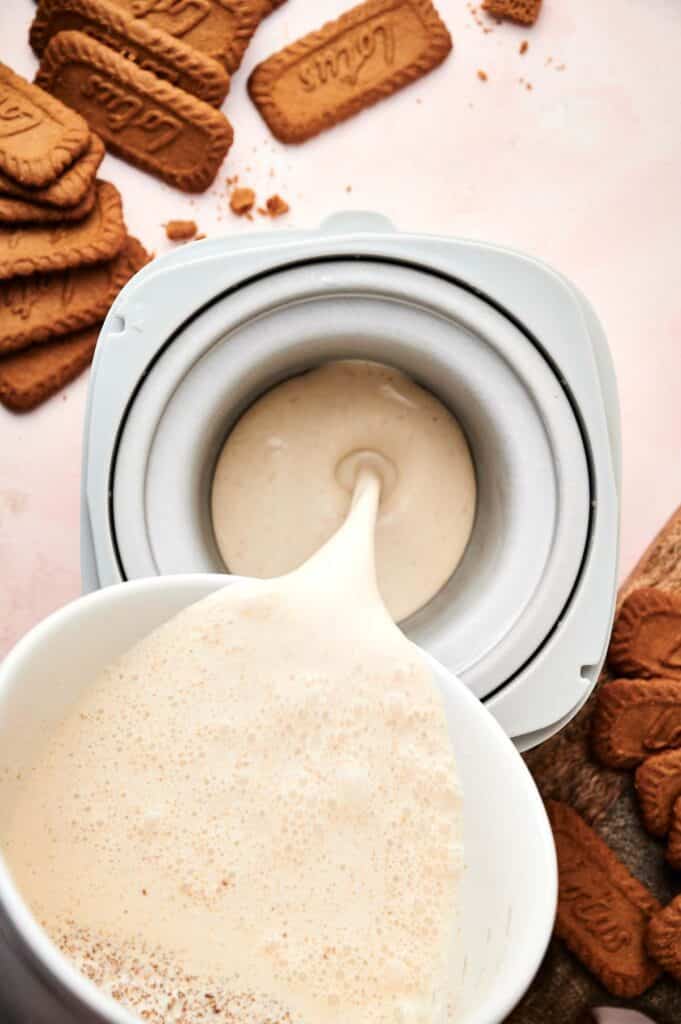
Pour the base into your ice cream maker, scraping the bowl well, as some of the Biscoff spread settles at the bottom and you want all of it. Churn according to your machine, usually around 25 minutes, until it reaches a soft-serve consistency, and stop there. Churning past that point works air out rather than in and costs you some of the creaminess.
Add the cookies and swirl
Transfer the soft ice cream to a freezer-safe container or a shallow baking dish. Fold in the crumbled cookies, then drizzle the rest of the Biscoff spread over the top and swirl it through with a few light passes of a spoon. You want visible ribbons, not a fully blended mix, so go gently.
Freeze until firm
Cover and freeze for two to four hours, until firm enough to scoop. This freezer step is where the ice cream sets. An eggless base like this one firms up in the freezer rather than coming out of the machine ready to eat, so the wait is doing real work, not stalling.
Recipe Notes and Expert Tips
- Get the base and the bowl cold first. The most common complaint with homemade ice cream is a batch that churns and churns but never firms up. Nine times out of ten, it’s a bowl that wasn’t frozen long enough or a base that sat out and warmed. Freeze your machine’s bowl fully, and keep the base cold right up until you pour it in.
- Crush the cookies coarsely, not fine. Big enough pieces to bite, so you get the cookies-and-cream contrast. Save a few crumbles to scatter on top at serving, where they stay crisp.
- Don’t over-churn. Pull it the moment it looks like soft serve. Past that, the texture turns dense and a little buttery instead of creamy.
- Keep the swirl a swirl. Fold the spread in with a light hand. Over-mixing turns your ribbons into a uniform beige, and half the pleasure here is the streak of cookie butter running through the scoop.
- Let it sit before scooping. Straight from the freezer, it’s hard. Five to ten minutes on the counter and it scoops cleanly and tastes creamier.
Recipe Variations
- Swap the crumbled Biscoff cookies for chopped chocolate, or add both, and you get a cookie-butter-and-chocolate version that plays the spice against the cocoa. I’ve tested this one, and it holds up well.
- A pinch of flaky salt over the finished swirl sharpens the caramel notes already in the Biscoff. It’s a small change I’ve tested often, and it comes down to your taste rather than the recipe’s.
- Folding in a handful of chopped toasted pecans with the cookies adds a warm, nutty crunch. I haven’t tested an exact amount here, so start with a small handful and add more next time if you want it.
How to Store Leftovers
Keep the ice cream in an airtight, freezer-safe container. If you froze it in an open baking dish, move it to a sealed container once it’s firm. Pressing a piece of parchment or plastic wrap directly onto the surface before you seal the lid helps slow the ice crystals that form on exposed ice cream.
In my kitchen, it’s at its creamiest within the first week, and I’d aim to finish it inside those 7 days rather than stretching it. A homemade base with no stabilizers in it only gets icier the longer it sits.
If you’re making it ahead for a specific day, make it 1 to 2 days out and keep it frozen the whole time, rather than freezing and part-thawing it more than once. Each thaw and refreeze coarsens the texture.
What to Serve With Biscoff Ice Cream
A scoop on its own with a few extra cookie crumbles and a drizzle of warmed Biscoff spread is where I’d stop most nights. If you want to build it out, sandwich a scoop between two soft chocolate chip cookies for an ice cream sandwich, or set it next to a slice of no-bake Biscoff cheesecake if you’re going all in on the cookie butter for a crowd.
For contrast, a handful of fresh raspberries cuts the heavy cream with a bit of tartness. And if you like a churned ice cream but want a back-pocket version that skips the machine entirely, my no-churn salted caramel ice cream is the one I turn to.
FAQs
Almost always it’s temperature. The machine’s bowl needs to be frozen solid, usually a full day ahead, and the base needs to go in cold rather than after sitting out. Remember too that this base sets in the freezer, not in the machine, so give it the full two to four hours to freeze and firm up.
Not this recipe as written. The churn is what gives it the dense, scoopable set. If you don’t have a machine, a no-churn method that whips the cream first is the route to take instead, and it produces a lighter, airier result.
I wouldn’t. Heavy cream is carrying the body and the richness here. Half-and-half has too little fat to set into a creamy scoop and tends to freeze harder and icier.
Give it a short burst in the microwave until it loosens, then whisk it straight in. Cold, stiff cookie butter leaves lumps in the base instead of blending smoothly.
More Sweet Recipes to Try
If this one’s your kind of dessert, here’s where I’d go next.
- Mini Biscoff Cheesecakes. The no-bake, individual-portion cookie-butter dessert, good when you’re feeding a few people and want them pre-plated.
- Tiramisu Ice Cream. The other churned, no-egg ice cream on the site, with a grown-up coffee-and-amaretto swirl for when it’s just the adults.
- No-Bake Oreo Cheesecake. If the cookies-and-cream idea is what you’re after, in a set-in-the-fridge slice with no oven.
- Salted Caramel Cheesecake. A make-ahead showpiece you can set on a Biscoff or graham cracker crust if you’ve got time to bake.

Ingredients
- 3 cups heavy cream
- 1 cup Biscoff spread divided
- ½ cup sugar
- 1 teaspoon pure vanilla extract
- 8-10 Biscoff cookies crumbled
Instructions
- In a large bowl, whisk together the heavy cream, half of the Biscoff spread, sugar, and vanilla extract for about 2 minutes, until the sugar dissolves. (Don’t worry if a few streaks of Biscoff remain!)3 cups heavy cream, 1 cup Biscoff spread, ½ cup sugar, 1 teaspoon pure vanilla extract
- Pour the mixture into your ice cream maker. Scrape the bowl well, as some Biscoff spread may settle on the bottom.
- Churn according to your machine’s instructions, usually about 25 minutes, until it reaches a soft-serve consistency.
- Transfer the churned ice cream into a baking dish or freezer-safe container. Gently fold in the crumbled cookies and drizzle in the remaining Biscoff spread. Swirl and mix lightly for ribbons of cookie butter throughout.8-10 Biscoff cookies
- Cover and freeze for 2–4 hours, or until firm.
- Scoop into bowls or cones and top with a Biscoff cookie for the ultimate finish!
Notes
Nutrition
