
Creme Brulee Cheesecake
 Add Preferred Source
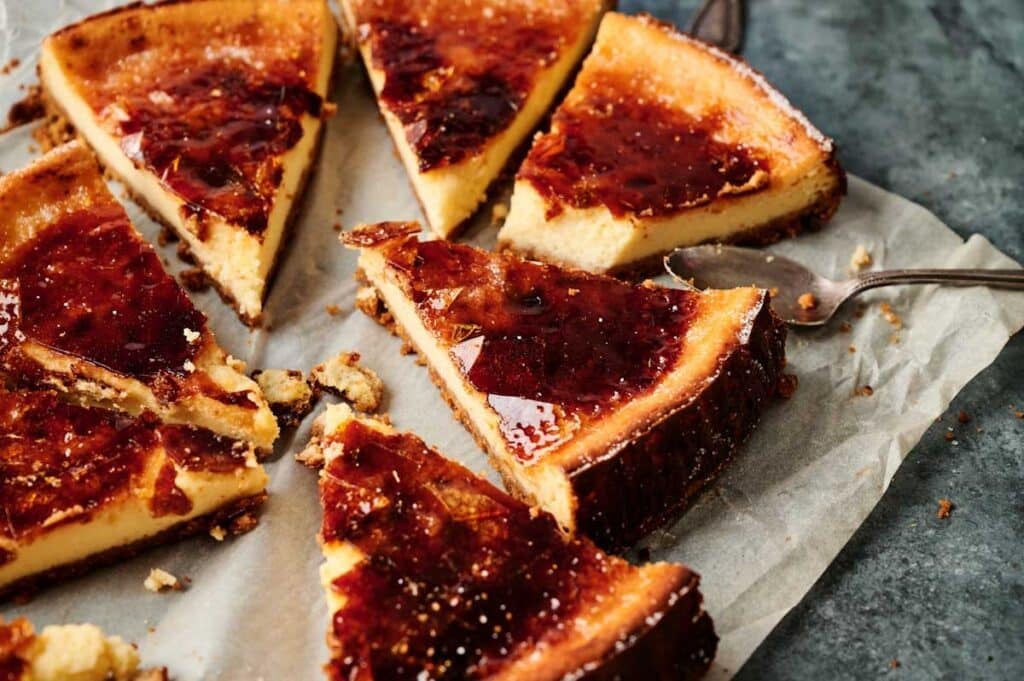
Crème Brûlée Cheesecake is the dessert I make when I want the table to go quiet for a second, without spending the whole day of the party worrying about it. I bake it the night before, chill it overnight, and torch the sugar top in the last few minutes before it goes out.
That crackle on top is the part everyone waits for, and it only stays crisp if you leave the torching until the end. That’s the whole trick, and it’s far easier than it looks.
This post contains affiliate links. As an Amazon Affiliate, if you purchase through those links, I earn a commission. Thank you!
Why You’ll Love This Recipe
- It’s a day-ahead dessert, so the only hands-on job left at the party is torching the top, about five minutes of work.
- The brûlée top gives you two textures in one slice: a thin, glassy crack over a soft, creamy filling.
- It sets without a water bath, one less fiddly step than most baked cheesecakes ask for.
- It’s a baked cheesecake set with eggs and a little cornstarch, so there’s no gelatin, and it’s vegetarian as written.
- One cheesecake serves twelve, enough for a holiday dessert table, and it makes an elegant stand-in for a birthday cake when you want something past the usual layer cake.
Ingredients You’ll Need
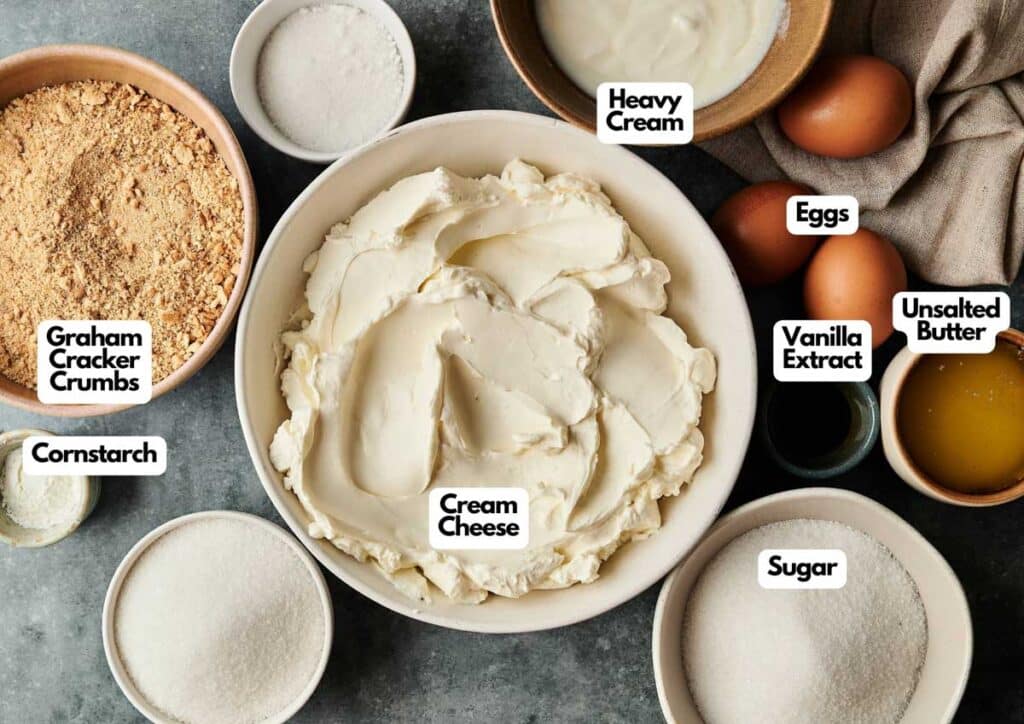
You’ll need all the ingredients shown in the photograph below.
- Cream cheese. Use full-fat blocks, not the spreadable tub kind, and let them soften properly. Cold cream cheese leaves lumps that no amount of beating fully smooths out, so leave it on the counter until it gives easily to a finger.
- Graham cracker crumbs. These make the base. If you’d rather start from scratch, my homemade graham cracker crust walks through the crumb-to-butter ratio; otherwise, fine pre-made crumbs press into a tidier, less crumbly base than coarse ones.
- Eggs. Three large eggs set the filling, and they also carry the custard flavor that makes this read as crème brûlée rather than plain cheesecake. I use the full tablespoon of vanilla alongside them, which keeps the eggs from tasting eggy.
- Cornstarch. Just a tablespoon. It helps the filling set to a clean, sliceable texture, which is part of why this recipe skips the water bath that most baked cheesecakes rely on.
- Granulated sugar for the top. Keep it separate from the sugar in the filling. Plain granulated is the one to use here; it melts evenly under a torch, where coarser or brown sugars scorch before they caramelize.
How to Make Crème Brûlée Cheesecake
A complete printable recipe and the measurements in both US customary and metric are available in the recipe card below.
Make the Crust
Heat the oven to 325°F (160°C). Mix the graham cracker crumbs, sugar, and melted butter until the crumbs look like wet sand, then press them firmly into the base of a 9-inch springform pan. I press the crust a little way up the sides, not just flat across the bottom, so no single bite is all crust. Bake for 10 minutes, then let it cool while you make the filling.
Prepare the Filling
Beat the softened cream cheese and sugar until smooth and creamy, scraping the bowl so no lumps hide at the bottom. Add the eggs one at a time, mixing gently after each, then stir in the heavy cream, vanilla, and cornstarch until the batter looks silky.
Go slow here. Beating too much air into the batter is the main reason a cheesecake puffs up and then cracks as it cools.
Bake the Cheesecake
Pour the filling over the cooled crust and set the pan on a rimmed baking sheet to catch any drips. Bake for 50 to 60 minutes.
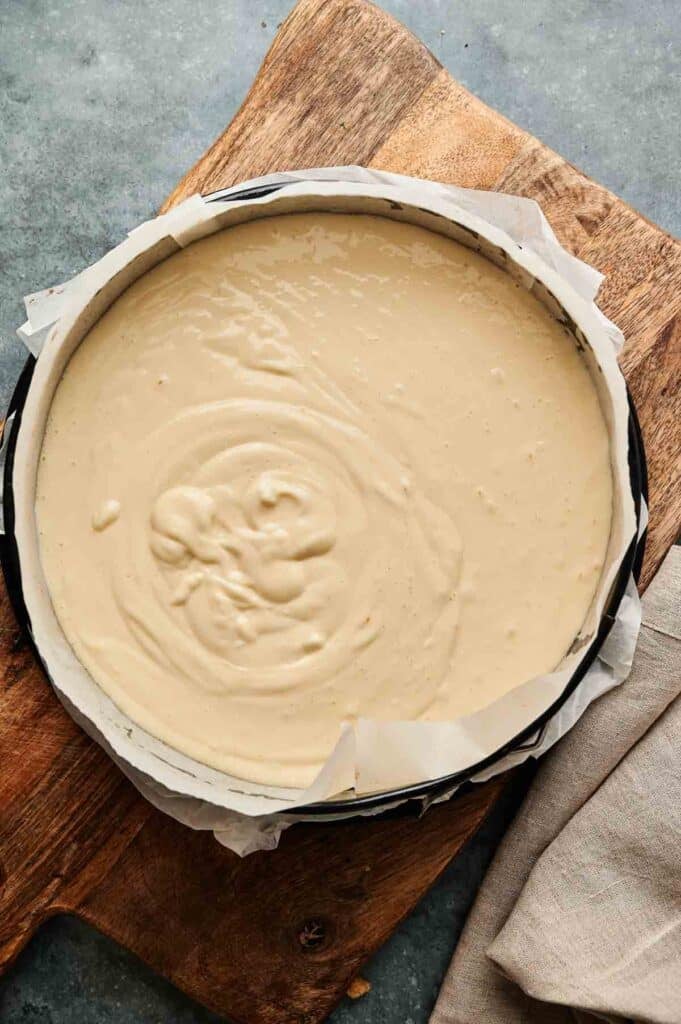
It’s done when the edges are set, but the center still has a slight wobble as you nudge the pan, so pull it on the wobble rather than waiting for a firm middle; it keeps setting as it cools and chills.
If yours needs a few extra minutes, that’s normal, since ovens run differently and a full pan holds its heat. Keep the oven door shut the whole time, because the temperature drop from opening it is another common cause of a cracked top.
Cool and Chill
Let the cheesecake cool at room temperature, but don’t leave it out indefinitely. Cream cheese and eggs are perishable, so get it into the fridge within two hours of leaving the oven, or within one hour if your kitchen is above 90°F (32°C), and let the rest of the setting happen in the cold.
Chill for at least 4 hours, or overnight if you can. Overnight is better; the texture firms up and the slices come out cleaner.
Make It Ahead
This is a make-ahead dessert by design. You can bake and chill it a full day before you need it, then hold the sugar topping until serving.
You can also freeze the plain, untorched cheesecake: wrap it well in plastic wrap and then foil, freeze it for up to two months for best quality, and thaw it overnight in the fridge before you torch the top. Frozen food stays safe well past that, but the texture is best inside the two-month window.
Add the Brûlée Top
Just before serving, sprinkle an even, thin layer of granulated sugar across the whole surface. Run a kitchen torch in small circles, keeping the flame moving, until the sugar melts and turns deep gold. A thin layer is the goal, thin enough that a spoon still breaks through cleanly.
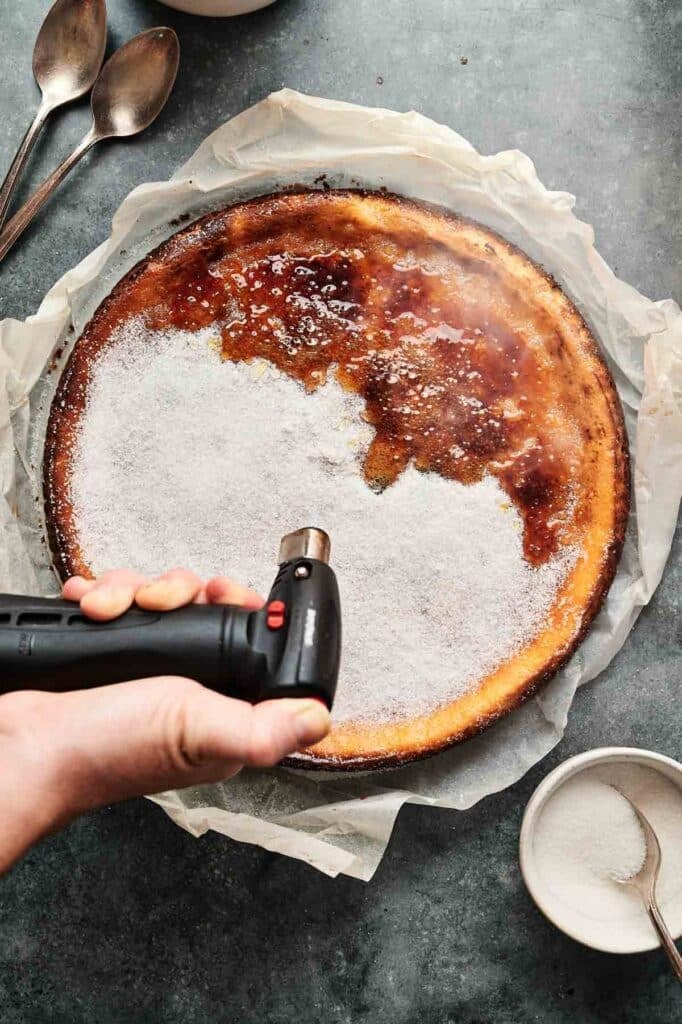
If you want a thicker shell, torch one thin layer, let it set, then add and torch a second. Let the top harden for a few minutes before you slice. The brûlée is the same technique behind a classic crème brûlée, just spread across a cheesecake instead of a ramekin.
Slice and Serve
Slice with a sharp knife, wiping the blade between cuts so the brûlée shards stay neat. Serve it chilled, when the contrast is sharpest: cold and creamy underneath, with a top that cracks like glass.
Recipe Notes and Expert Tips
- Pull it on the wobble. A cheesecake baked until the center is firm is already overbaked, and overbaking is what turns the filling dense and a little eggy. Take it out while the middle still jiggles; it sets as it chills.
- Torch per slice when you’re serving slowly. The caramelized top softens the longer it sits on a chilled cake, so if dessert is going out in waves, sprinkle and torch only the portion you’re serving.
- Skip the water bath, keep the insurance. This filling sets without one, but the anti-crack habits still matter: soften the cream cheese fully, mix on low, keep the oven shut, and cool it gradually.
- Use a real torch over the broiler. A handheld torch caramelizes the sugar without warming the filling underneath, which a broiler struggles to do.
Recipe Variations
- Swap the vanilla extract for vanilla bean paste or the scraped seeds of a whole pod, for visible flecks and a deeper vanilla that brings it closer to true crème brûlée. I’ve tested it this way, and it’s what I do when the cheesecake is the centerpiece rather than one dessert among several.
- Building the brûlée in two thin layers instead of one, torching and cooling between them, is a well-supported way to get a thicker, sturdier shell from the same sugar.
- A spoon of espresso powder beaten into the filling turns it in a coffee direction, closer to a tiramisu note. I haven’t tested that exact amount here, so start small, around a teaspoon.
How to Store Leftovers
Keep leftover cheesecake tightly covered in the fridge, and eat it within 3 to 4 days. That’s the safe window for a baked cream cheese and egg dessert, and the texture holds well across it.
The brûlée top is the one part that doesn’t keep. The caramelized sugar softens within hours in the cold, so it’s at its best the day you torch it. If you know you’ll have leftovers, torch only what you’re serving and leave the rest of the cheesecake bare; you can sprinkle and torch fresh sugar on a slice when you come back to it.
Freezing is for the untorched cake only, and the untorched cake freezes wrapped for up to two months. Thaw in the fridge before adding the brûlée topping.
What to Serve With Crème Brûlée Cheesecake
This is a rich slice, so I keep what goes alongside it sharp and simple. A spoon of fresh berries or a little homemade strawberry topping cuts through the cream without competing with the brûlée top. A small cup of strong espresso does the same job in liquid form, and a short pour of dessert wine suits it when the occasion is dressy.
I wouldn’t pile anything heavy next to it; the cheesecake is the dessert, and the rest is just there to balance the richness.
FAQs
A kitchen torch gives you the most control, but a broiler can work in a pinch. Set the thoroughly chilled cheesecake on the top rack close to the element, watch it every second, and pull it the moment the sugar turns gold, usually in a minute or two. The risk is that the broiler warms the filling while it caramelizes the top, so speed matters.
Cracks almost always trace back to too much air beaten into the batter, an oven door opened mid-bake, or overbaking. Mix on low, keep the door shut, and pull the cheesecake while the center still wobbles. A few hairline cracks also disappear under the sugar top, so they’re rarely worth worrying about here.
That’s almost always overbaking. A cheesecake pulled while the center still wobbles stays creamy, while one baked until the middle is firm tightens up and can start to taste of egg. Take it out on the wobble, and use the full tablespoon of vanilla, which keeps the custard flavor forward.
Not for this recipe. The cornstarch in the filling helps it set, and the gradual cooling does the rest, so there’s no foil-wrapped pan or tray of hot water involved.
More Cheesecakes I Keep in My Back Pocket
If this one becomes a regular at your table, here are the other cheesecakes I make when an occasion calls for something special.
- Pumpkin Cheesecake. Where I turn to when the weather cools, and vanilla feels too plain, spiced through and finished with caramel.
- Salted Caramel Cheesecake. The one to make if the caramelized top is your favorite part of this recipe, finished with a salted caramel topping of its own.
- Pecan Pie Cheesecake. It folds two classics into a single slice, which suits a holiday table with room for only one big dessert.
- Tiramisu Cheesecake. For when I’m in a coffee mood rather than a vanilla one, with mascarpone and a proper hit of coffee.

Equipment
Ingredients
For the crust:
- 1 ½ cups graham cracker crumbs
- ¼ cup sugar
- 5 tablespoons unsalted butter melted
For the filling:
- 24 ounces cream cheese softened
- 1 cup sugar
- 3 large eggs
- 1 cup heavy cream
- 1 tablespoon vanilla extract
- 1 tablespoon cornstarch
For the topping:
- ¼ cup granulated sugar

Video
Instructions
- Preheat the oven to 325°F (160°C). In a bowl, mix graham cracker crumbs, sugar, and melted butter. Press the mixture firmly into the bottom of a springform pan. Bake for 10 minutes, then let cool.1 ½ cups graham cracker crumbs, ¼ cup sugar, 5 tablespoons unsalted butter
- In a large bowl, beat cream cheese and sugar until smooth and creamy. Add eggs one at a time, mixing gently after each addition. Stir in heavy cream, vanilla extract, and cornstarch until combined. Pour over the cooled crust.24 ounces cream cheese, 1 cup sugar, 3 large eggs, 1 cup heavy cream, 1 tablespoon vanilla extract, 1 tablespoon cornstarch
- Place the pan in the oven and bake for 50–60 minutes, or until the center is set. Remove and let cool completely.
- Refrigerate the cheesecake for at least 4 hours, or overnight for best results.
- Before serving, sprinkle sugar evenly over the chilled cheesecake. Using a kitchen torch, caramelize the sugar until golden and crisp. Allow to cool for a few minutes so the topping hardens.¼ cup granulated sugar
- Serve & enjoy! Slice and enjoy the creamy cheesecake with its crackly brûlée topping.
Notes
Nutrition

Really good. somewhat eggy and very creamy. I used regular heavy whipping cream and it turned out fine, just needed longer time in the oven than suggested. I also recommend for anyone else following this recipe to spread the crust to the sides as much as possible, as the crust is extremely thick.
Looks delicious. What size springform pan did you use? Thanks.
I use a standard 9-inch springform pan for this one. Hope you love it, and let me know how it turns out!